Table of Contents
About this project
Challenge Objective
For the Maven Everest Challenge, I played the role of a data journalist tasked with telling the story of mankind’s quest to conquer Mount Everest.
Using real expedition data, my goal is to craft a compelling visual narrative that highlights things like key milestones, shifting strategies, and the climbers who dared to reach the top of the world.
About The Data Set
This dataset, based on the archives of Elizabeth Hawley, provides a comprehensive record of mountaineering expeditions in the Nepalese Himalaya, spanning from 1905 to 2024. It includes detailed information on 89,000+ members across 11,000+ expeditions and 480 mountain peaks, including dates, successes, and significant events.
Cleaning Your Data
For the ‘Exped’ Table:
- Remove Duplicates: Get rid of any rows where the expedition ID is exactly the same, so each one is only listed once.
- Fill in Blanks: I go through all columns and fill in any empty spaces where information is missing.
For the ‘Member’ Column:
- Make Full Names: Combine the “first name” and “last name” into one new column called “Name” for each person. Data Modeling 1. exped table (Fact table)
- One row = one expedition
2. members table (Detailed info on people)
- One row = one member of an expedition Key columns: memid, expid, citizen, sex, age, yob, msuccess, death, hired, died, duty, etc.
3. peaks table (Dimension)
- One row = one mountain Key columns: peakid, peakname, heightm, region Key columns: expid, peakid, year, season, termreason, highpoint, success, basecampdate, terminationdate, oxygenused, etc.
DAX
Then I wrote all DAX.
1 TotalExpeditions
= DISTINCTCOUNT(exped[expid])
2 Age Group =
SWITCH( TRUE(),
‘members'[AgeAtExpedition] < 20, “Under 20”,
‘members'[AgeAtExpedition] < 30, “20-29”,
‘members'[AgeAtExpedition] < 40, “30-39”,
‘members'[AgeAtExpedition] < 50, “40-49”,
‘members'[AgeAtExpedition] < 60, “50-59”,
‘members'[AgeAtExpedition] >= 60, “60 and Over”,
“Unknown”
)
3 AgeAtExpedition
= ‘members'[myear] – ‘members'[yob]
4 SuccessfulSummitsByNation =
CALCULATE(
COUNTROWS(‘members’),
‘members'[msuccess] = TRUE()
)
5 SuccessRate = DIVIDE([TotalSubmits], [TotalExpeditors], 0)
6 Total Deaths = COUNTROWS(FILTER(‘members’, ‘members'[death] = TRUE()))
7 TotalExpeditors = COUNT(‘members'[membid])
8 TotalSubmits =
CALCULATE(
COUNTROWS(‘members’),
‘members'[msuccess] = TRUE()
)
📊 Analysis
This report presents key insights into the evolution of Himalayan expeditions, particularly the pursuit of Mount Everest. The findings are based on data spanning over a century, highlighting changes in strategy, participation, and outcomes.
🏔️ Expedition Trends
- There has been a consistent upward trend in expedition activity since the early 1900s, peaking in the 2010s with 3,705 expeditions, marking it the most active decade.
Spring remains the dominant climbing season, accounting for 49.36% of expeditions (5,634 total), followed by autumn and summer.
Expedition sizes have increased over time, with 17,000+ members recorded in the 2010s alone.

⚠️ Fatalities and Risk
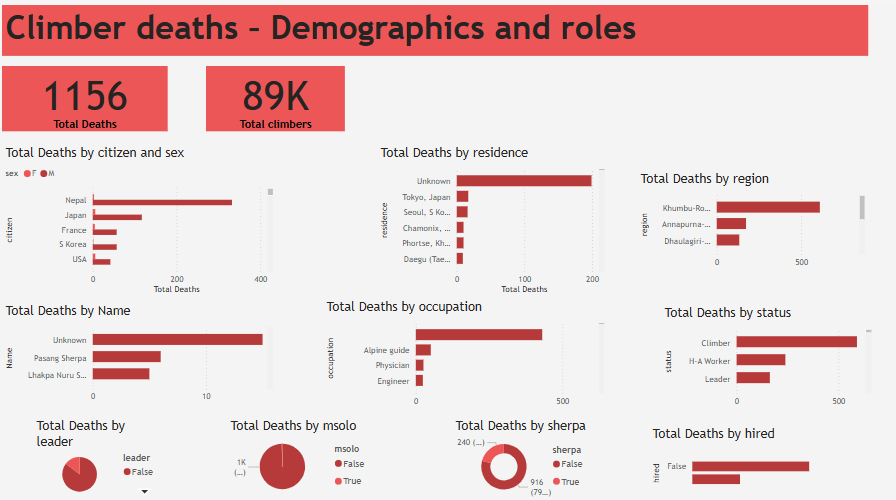
- The overall mortality rate has decreased significantly, from 2.5% in the 1900–1970s to approximately 0.8% in recent decades.
Environmental hazards are the leading cause of fatalities (36.59%), which include avalanches, extreme weather, and altitude sickness.
205 climbers have died during Everest expeditions alone, emphasizing the ongoing risks associated with the climb.
🧍♂️🧍♀️ Climber Demographics
- Male climbers consistently outnumber females, with peak participation in the 2010s: 14,000 males vs 1,900 females.
Female participation has steadily increased, reflecting greater inclusivity in recent years.
82.37% of participants are climbers, while 17.63% have leadership or support roles.
A large share of climbers originate from Asian and European countries, with Nepal, India, USA, and Japan being the top contributors.
🧪 Summit Success and Strategy
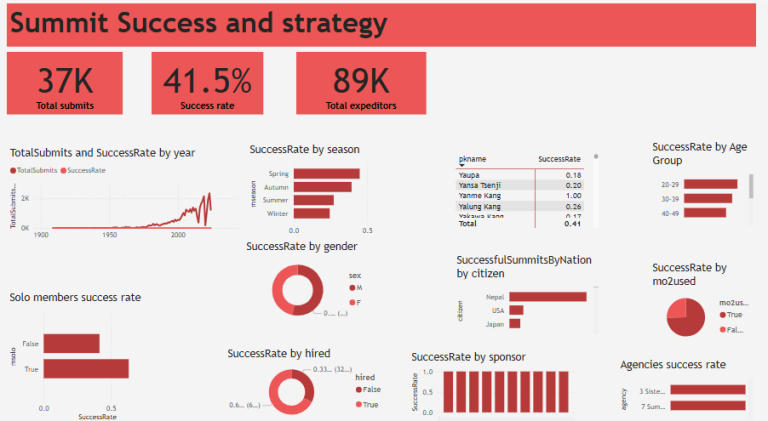
- Of the 2,341 Everest expeditions, 1,487 were successful, resulting in an impressive 63.5% success rate. The use of supplemental oxygen has a significant impact on summit success. Climbers using oxygen consistently show higher success rates.
Solo climbers have notably lower success and higher risk compared to group expeditions.
Hired support members show slightly higher success rates, highlighting the value of experienced guides and sherpas.
🏔️ Peak Analysis
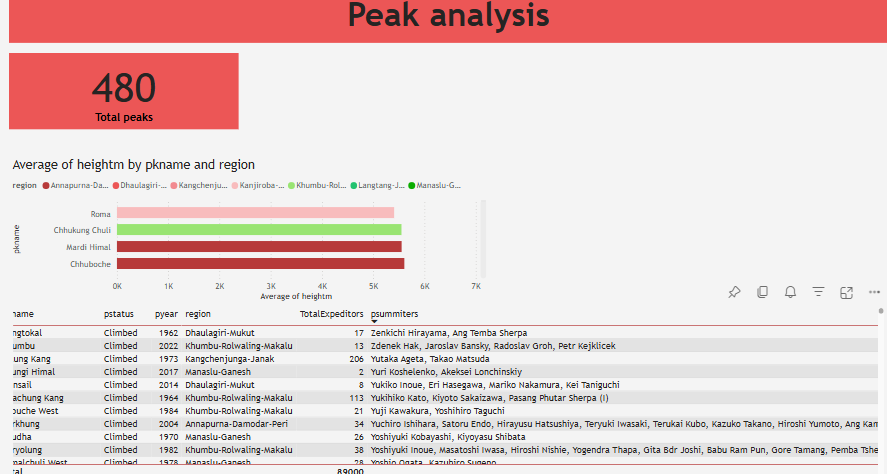
- Mount Everest stands as the most climbed and highest peak at 8,849 meters.
Other frequently attempted peaks include Manaslu, Annapurna, and Dhaulagiri, each with varying success and fatality rates.
Some lesser-known peaks remain unclimbed, often due to extreme conditions or restricted access.
🗓️ Historical Milestones
- 1953: First successful Everest ascent by Edmund Hillary (New Zealand) and Tenzing Norgay (India/Nepal).
1978: First ascent without supplemental oxygen by Reinhold Messner and Peter Habeler.
1980: Reinhold Messner completes the first solo ascent of Everest.
End result
